
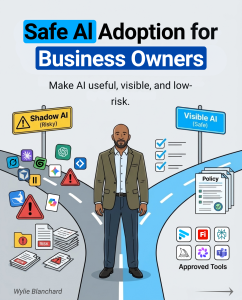
Click the image to view the guide.
AI decisions may already be happening without you
Your team may already be using AI across your business.
That is not automatically a bad thing. In many cases, employees are trying to save time, move faster, or remove friction from work that is slower than it needs to be.
The risk is not that people are being careless. The risk is that leaders may not be able to see which tools are being used, what data is being shared, or which shortcuts are becoming part of the workflow.
That is where safe AI adoption starts. Not with a ban. Not with a tool purchase. With visibility.
What shadow AI looks like in a real business
Shadow AI happens when employees use AI tools, features, or workflows outside the normal view of leadership, IT, security, or compliance.
It might look like:
- A customer message drafted in a personal AI account
- A contract summarized in a public tool
- A spreadsheet uploaded to speed up reporting
- A vendor adding an AI feature without review
- A department building its own workflow outside approved systems
Most of this does not start with bad intent. It starts with friction.
If the approved process is too slow, the team will find a faster one. If the safe path is unclear, the convenient path wins.
Banning AI is not the same as managing AI
A strict ban can feel like control, but it often creates a different problem.
People still have work to do. They still have deadlines. They still need faster ways to draft, summarize, research, analyze, and respond.
If the business does not define the safe path, employees may define the convenient one.
That means leaders need to answer a few practical questions:
- Which AI tools are approved?
- Which use cases are allowed?
- What data is off-limits?
- Who reviews new AI tools or features?
- How should employees ask for help?
This is a governance issue, but it does not need to be complicated.
The SAFER AI Framework
A simple way to start is the SAFER AI Framework.
S: See current AI use
Find out where AI is already being used. Ask teams what tools they use, what tasks they use them for, and what data might be involved.
A: Approve tools and use cases
Do not just tell people to use approved tools. Name the tools. Name the acceptable use cases. Name the owner.
F: Fence sensitive data
Make the data rules simple. Customer records, employee information, contracts, financial data, passwords, access details, and regulated data should not go into unapproved tools.
E: Ease risky workflows
Shadow AI often points to a broken workflow. Look for tasks that are slow, unclear, repetitive, or poorly supported.
R: Review and improve
AI tools change. Vendor features change. Employee behavior changes. Set a review rhythm so the business can adjust before risk grows.
A 30-day starter plan for business owners
You do not need a perfect AI program to start. You need a clear first month.
Week 1: Find current AI use
Ask each department where AI is already being used. Keep it non-punitive. The goal is visibility, not blame.
Week 2: Define approved tools and off-limits data
Create a short list of approved tools. Then create an even clearer list of data that should not be entered into unapproved AI tools.
Week 3: Pick two or three safe use cases
Start with practical, lower-risk use cases. Examples include internal drafting, meeting summaries, research support, and first-pass document outlines.
Week 4: Train the team and assign ownership
Explain the rules in plain English. Name the person or team responsible for reviewing AI questions, vendor changes, and new use cases.
Safe AI adoption checklist
Use these questions before AI adoption grows faster than your controls:
- Do we know which AI tools are being used?
- Do we have an approved tool list?
- Have we named off-limits data?
- Do employees know how to ask for AI help?
- Do we know which workflows are creating workarounds?
- Do we have one owner for AI review?
- Do we review new AI features from existing vendors?
- Do we train employees on what not to upload, paste, or share?
A short checklist is better than a long policy no one reads.
Why this matters more in regulated or trust-heavy businesses
For healthcare, nonprofit, finance, education, and other trust-heavy organizations, AI adoption is not just a productivity decision.
It can affect privacy, auditability, vendor oversight, customer trust, and operational resilience.
That does not mean leaders should avoid AI. It means they should build structure early.
The goal is not to slow the business down. The goal is to make AI useful without losing visibility, control, or trust.
Make AI visible before it becomes risky
AI is already becoming part of daily work.
The businesses that handle it well will not be the ones that pretend it is not happening. They will be the ones that make safe usage clear, practical, and easy to follow.
Start with visibility. Define the safe path. Fence the data. Fix the workflows that create workarounds. Then review the process often enough to keep up.
Safe AI adoption does not have to be complex.
But it does need an owner.
Originally shared on LinkedIn, expanded here with additional context and practical next steps.