
AI Governance Is Not a Technology Problem. It’s a Decision Ownership Problem
A lot of organizations think AI governance starts with picking the right tool.
It usually doesn’t.
The real issue starts earlier. It starts when teams begin making AI decisions without a clear owner, a shared review process, or agreed guardrails.
That is why AI governance is not mainly a technology problem.
It is a decision ownership problem.
The first AI tool rarely creates the biggest risk. The second one usually does not either.
The trouble begins when AI adoption spreads team by team, workflow by workflow, and exception by exception. No single decision feels large enough to raise concern. But over time, those small decisions create a pattern. Eventually, the business finds itself operating with an AI strategy no one intentionally designed.
Not because people were careless.
Not because teams were resisting policy.
Because no one was clearly responsible for the decisions behind the policy.
When that happens, AI stops being a simple innovation effort. It becomes a leadership blind spot.
Why this matters now
Most businesses are not struggling to find AI tools.
They are struggling to answer basic operating questions about them.
- Who can approve a new use case?
- Who decides whether a tool is safe enough for business use?
- Who reviews how customer data, patient data, or internal business data may be used?
- Who makes sure employees are following the rules once the tool is in place?
If those answers are unclear, the organization may have AI activity, but it does not yet have AI governance.
That distinction matters.
Without governance, AI adoption tends to create four predictable problems:
- Tool sprawl
Different teams adopt different tools for similar work, which increases cost, confusion, and inconsistency. - Risk gaps
Sensitive data may be entered into tools without enough review of privacy, security, or contractual obligations. - Process inconsistency
One department may have a thoughtful approval process while another moves ahead informally. - Leadership blind spots
Executives believe AI use is limited and controlled, while actual usage is broader and harder to track than expected.
What strong AI governance actually looks like
Good AI governance is not about slowing everything down.
It is about making important decisions visible before they become expensive.
That means leaders need a clear way to answer a few basic questions across the business.
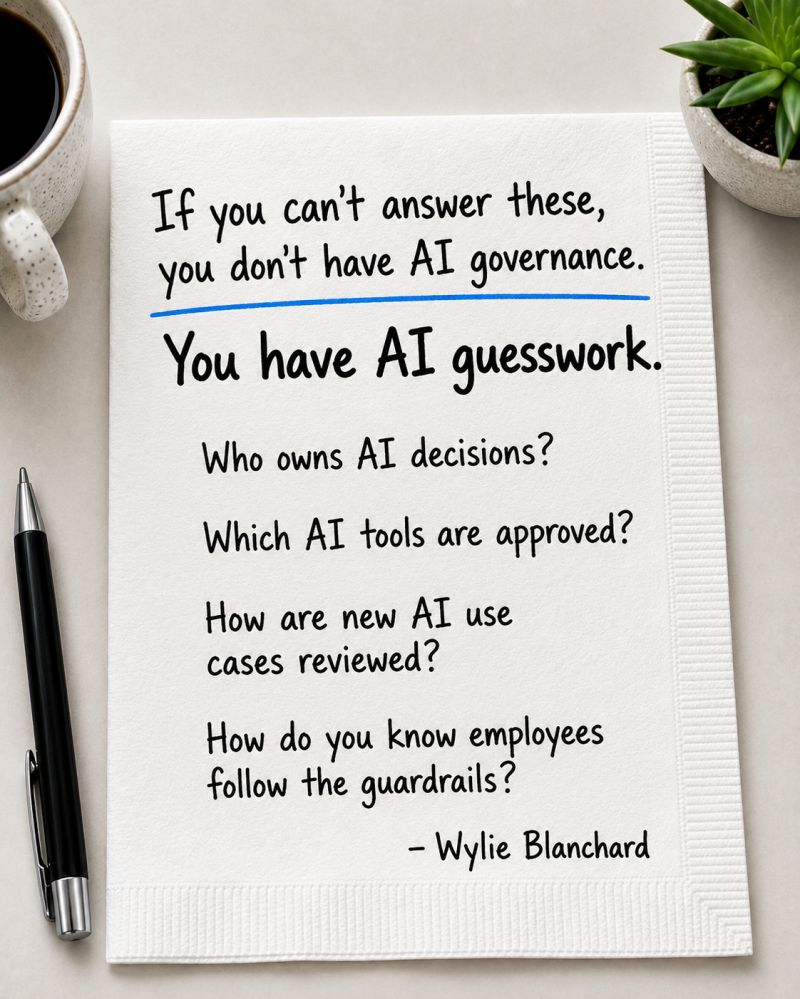
Here is a simple test.
- Who owns AI decisions across the business?
This is the first question because ownership drives everything else.
Someone, or a clearly defined group, needs to be accountable for how AI decisions are made. That does not mean one person makes every decision. It means someone owns the framework, the approval path, and the accountability.
If ownership is scattered, governance will be scattered too.
- Which AI tools are approved, and why?
Most organizations can name a few popular tools. Fewer can explain which ones are approved for business use and why those tools made the list.
Approval should not be based only on popularity or convenience. It should reflect practical business criteria such as security, data handling, use case fit, and integration with existing operations.
If leaders cannot point to an approved list with a clear rationale, employees will create their own.
- How are new AI use cases evaluated before they spread?
A new use case may sound harmless at first.
Summarizing meeting notes.
Drafting client emails.
Analyzing internal data.
Supporting customer service.
Each one may appear manageable in isolation. But each one can raise different questions about privacy, quality control, bias, compliance, and operational impact.
Organizations need a repeatable way to review new use cases before they become normal practice. The goal is not red tape. The goal is consistency.
- How do you know employees are following the guardrails?
Policies alone do not create governance.
Leaders need a way to verify that guardrails are understood and followed. That may include training, documented guidance, periodic reviews, usage monitoring, manager accountability, or a lightweight internal reporting process.
If the organization cannot see how AI is being used in practice, it cannot confidently say governance is working.
A starting point for leaders
If your organization is early in this work, do not overcomplicate it.
Start with three actions.
- Name the owner
Assign clear accountability for AI governance. This may be one executive sponsor with a cross-functional working group from IT, security, operations, legal, compliance, and business leadership. - Create an approved-use baseline
Document which tools are approved today, which uses are allowed, and which uses require additional review. - Set a simple intake process
Create a lightweight path for teams to request or propose new AI use cases. Keep it clear. The goal is visibility and consistency, not bureaucracy.
For regulated industries such as healthcare, finance, and education, this becomes even more important. AI decisions can affect privacy obligations, audit readiness, and stakeholder trust. But even outside regulated environments, unclear decision ownership still creates operational risk.
The organizations that benefit most from AI will not automatically be the ones using the newest tools.
They will be the ones making the clearest decisions.
That is what governance really is.
Not control for the sake of control.
Clarity about who decides, how decisions are made, and how the business stays aligned as AI use grows.
If your team cannot clearly answer who owns AI decisions, which tools are approved, how new use cases are reviewed, and how guardrails are enforced, then your AI strategy may not be as clear as it looks.
That is fixable.
And it starts with ownership.
Originally shared on LinkedIn, expanded here with additional context and next steps.