
Low-code can help teams move faster.
But speed at the beginning does not guarantee lower cost at the end.
A lot of leaders hear the same promise:
Build faster.
Launch sooner.
Clear the backlog.
Give the business what it asked for.
Then, after launch, the real invoice shows up.
I hear some version of this often:
“We built it in low-code.
It’s 90% there.
Can you help us finish the last 10%?”
Usually, the answer is no.
Not because the platform is bad.
Because the last 10% is often where the hard parts live.
That is where teams run into integration gaps, unclear ownership, weak access controls, support issues, reporting needs, and compliance questions that should have been addressed much earlier.
The app looked simple in week one.
Production made it expensive.
Why the last 10% costs so much
Most low-code projects start with a reasonable goal:
move faster and reduce manual work.
That part makes sense.
The problem is that many teams treat the early build like the whole project.
It is not.
The hard part is usually not getting a screen to work.
The hard part is making the workflow hold up in the real world.
That means asking questions like:
- Who owns the process after go-live?
- How does this connect to the rest of the environment?
- What happens when volume grows?
- Who approves access and monitors changes?
- What does support look like when the original builder moves on?
If those questions show up late, cost shows up late too.
Where cleanup usually starts
In most cases, cleanup begins in one of five places.
- Process
The workflow gets built before the process is fully defined.
That leads to rework, exceptions, and confusion after launch. - Integrations
Teams treat integrations like a follow-up task.
Then they find out the app depends on data, systems, or handoffs that were never fully mapped. - User adoption
The people who actually use the workflow were not involved early enough.
Now the tool works technically, but not operationally. - Governance
Access, data handling, audit needs, and oversight are added after the build is already moving.
That gets expensive fast, especially in regulated environments. - Ownership
Nobody has a clear answer for who maintains the app, updates rules, handles support, or decides what changes next.
Low-code reduces build time.
It does not remove the need for sound decisions.
What leaders should ask before approving the build
Before a low-code project moves forward, I would want clear answers to these questions:
- What business problem are we solving?
- Which teams, systems, and data sources are involved?
- Who will use it, approve it, support it, and own it?
- What compliance, audit, or security requirements apply?
- What has to be true for this to still work six months after launch?
Those questions slow down bad assumptions.
They also protect the budget.
A better way to think about speed
Speed is useful.
But speed without clarity usually turns into cleanup.
The most expensive app is often the one that looked easy in the first meeting.
That matters even more in healthcare, finance, education, and other regulated settings, where weak process design and late governance decisions create more than inconvenience. They create operational risk.
If a low-code project is already underway, the goal is not to panic.
The goal is to step back early enough to define the process, confirm ownership, review integrations, and address controls before the cleanup grows.
Low-code can be a smart move.
Just do not wait until the last 10% to bring in the thinking that should have shaped the first 90%.
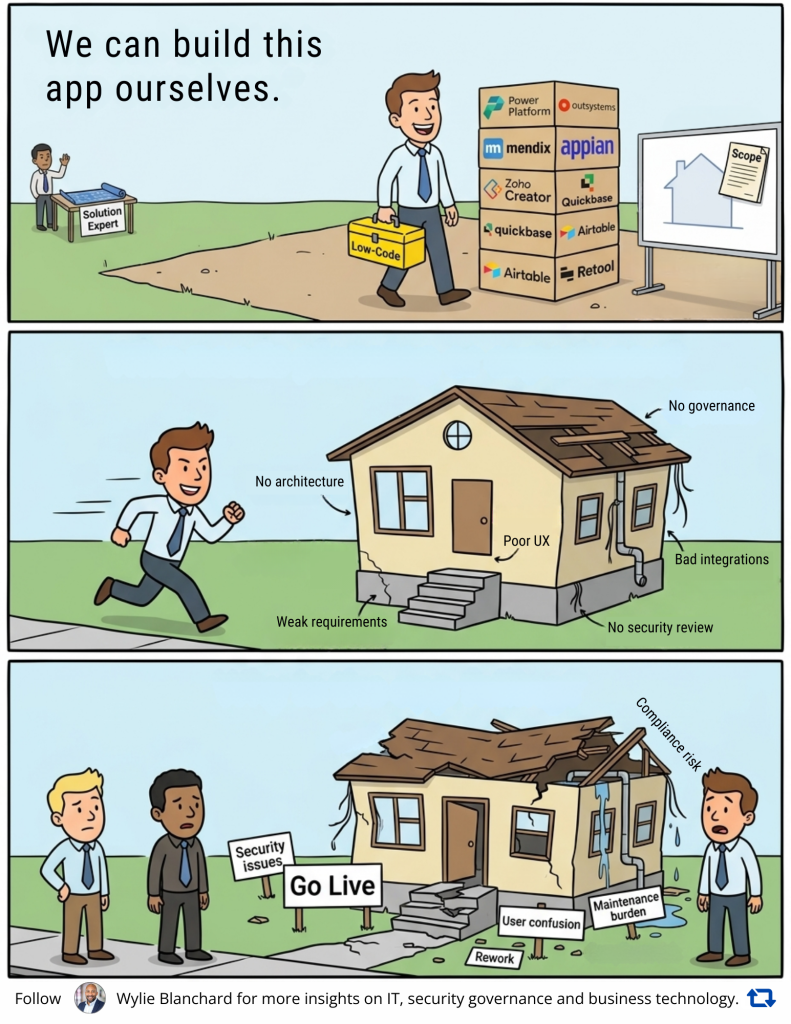
Originally shared on LinkedIn, expanded here with additional context and practical next steps.